Life Flight Network Paramedic with 1,500 Missions Steps Up to Donate Amid Severe Blood Shortage
By Rebecca Marshall
As a flight paramedic for Life Flight Network, Gary McQueen has made a career out of providing emergency lifesaving care and transport to patients suffering severe trauma or fighting a life-threatening illness or injury. Today, he’s doing something a little different— he’s donating blood at Life Flight Network’s headquarters in Aurora, Oregon.
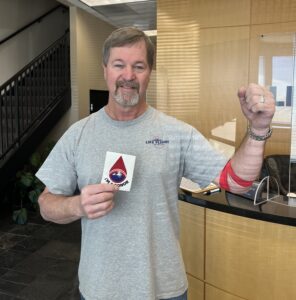
“As someone who is an end user of this product, I appreciate donors more than I can explain,” he says.
He has a red bandage on his arm and enjoys the juice and snacks provided after you donate blood to the Red Cross. He has the kind of calm demeanor that you’d expect from a paramedic who’s flown close to 1,500 air medical missions , but he was excited to share how he utilizes donated blood when caring for his patients.
“Almost all our aircraft carry blood products on board. Every morning, at the start of shift, we check blood temperatures to ensure our blood is safe and ready to go. We have a refrigerator and a cooler—everything is monitored 24/7. And every time I pick up a unit of blood, I look at it and think ‘someone gave this’. Someone took time out of their day to donate and we’re going to use it the best way possible—to save someone’s life. That’s why it matters. And that’s why I’m grateful to every person who gives.”
Gary says he sees this importance day after day. When he arrives at a car accident or at a hospital, he knows almost immediately if someone is going to need blood.

“One case that sticks with me was a woman on Interstate 84 in Eastern Oregon. She had somehow fallen out of her vehicle, and when we walked up, there was a large amount of blood on the pavement. Based on what we saw, it was an easy decision. We knew immediately we’d be giving her blood on the way to the hospital. And that intervention mattered.”
In another case, they had to give a patient two units of blood and two units of fresh plasma while in flight. This was in addition to what was given to the patient before he had even left the hospital. In all, that patient had 14 units of blood and plasma before he made it to a Portland hospital. He survived. With how critical the need for blood is in Gary’s line of work, you’d think it would be easy to come by but there have been times when that wasn’t the case.
“During and coming out of COVID—it was a really hard time. There were periods when we simply didn’t have blood,” says Gary. “I remember a severe trauma patient in Central Oregon who needed to get to Portland. We only had one unit of blood, and I knew she wouldn’t survive the flight over the mountains. So, we diverted and landed at The Dalles so we could get the patient the blood they needed faster before getting them to the specialty care they needed in Portland.”
These are just a few examples of the trauma that Gary has seen. It’s what motivates him, and his coworkers, to give blood when they have drives like these.
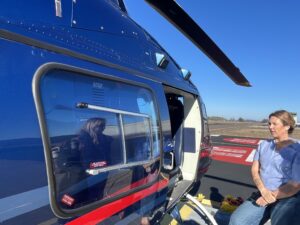
Natalie Hannah is the Public Relations Manager for Life Flight Network, which has 34 bases of operation across Oregon, Washington, Idaho, Montana, and Hawai‛i and transports 15,000 patients annually. That number is expected to grow as the need for air medical resources continues to rise in response to population growth and the reduction of specialty healthcare services in many rural areas.
She says she set up this blood drive because, as an organization that uses blood to save lives, they are acutely aware of the blood shortage the country is facing, and she wanted to do something about it. This is one of many drives she’s organized over the past two years. They even offer their employees incentives to donate blood by awarding prizes for donation milestones, including a week of paid time off as a top prize.
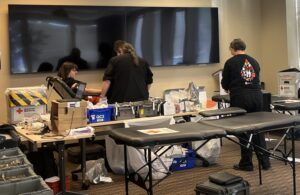
Just steps from the place where their helicopters and planes take off and land at the Aurora airport, a steady stream of people come in throughout the day. In the end, the Life Flight Network team donated 19 units of blood.
The Red Cross and Life Flight Network have something in common; they both know help can’t wait in emergencies and blood can be the difference between life and death. Right now, the American Red Cross is facing a severe blood shortage as requests from hospitals exceed the available supply of blood, drawing down the blood supply by about 35% over the past month. As we head into February, extreme winter weather continues across much of the country forcing the cancellation of even more blood drives.
If you can donate blood, now is the time. Book an appointment now to give blood by using the Blood Donor App, visiting RedCrossBlood.org or calling 1-800-RED CROSS (1-800-733-2767).
To learn more about the LifeFlight Network, click HERE.
To learn more about the Red Cross in Oregon and SW Washington, click HERE.
###