As a Teen, She Was the Only Survivor of a Plane Crash. Today, She’s Giving Back Through Blood Donation
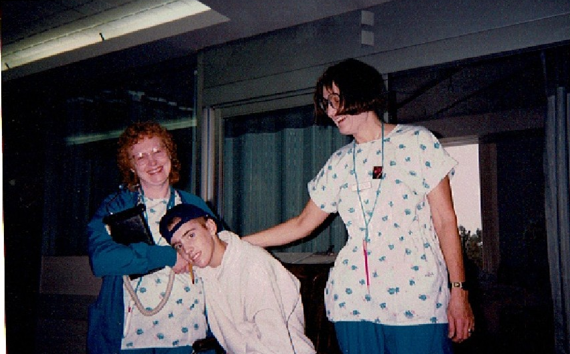
Written by Katherine Liu, Red Cross Volunteer
While Kate Robinson donates blood with the Red Cross today, she was once on the other side of the equation. Decades ago, an accident left her relying on blood transfusions to survive.
25 years ago, in September of 1991, Kate traveled to Black Butte, Oregon, to celebrate her 16th birthday with her friends. Her father and another pilot later flew in to pick her up along with one of her friends.
During takeoff in Sisters, Oregon, the wing of the aircraft struck a tree, causing it to crash.
Kate doesn’t remember the accident itself. A brain injury left her with retrograde amnesia, a medical condition where a person cannot remember events or information from before a brain injury or trauma occurred. Kate has no recollection of her life before she was 16, and what she knows about the crash comes from what her family and others have told her.
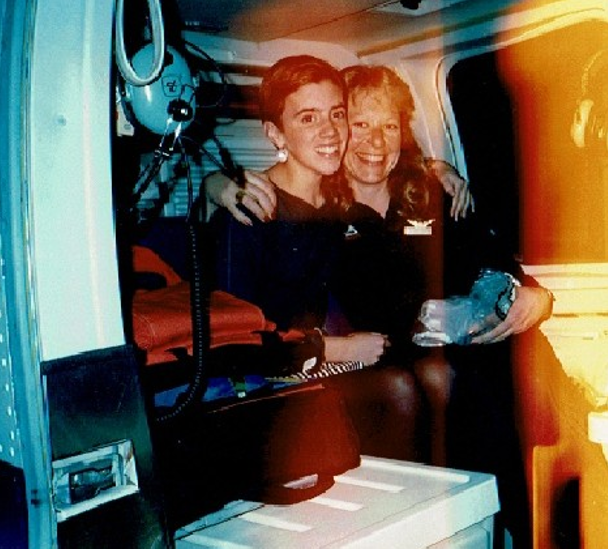
The other three people inside the plane passed away, leaving Kate as the only survivor. When the life flight helicopter arrived, Kate was not breathing, and required blood transfusions to survive. She was taken to St. Charles Hospital, where doctors discovered extensive injuries, including a subdural hematoma, a broken femur, facial injuries and a collapsed lung. She was in a coma and underwent multiple surgeries simultaneously. “I think they were [just] trying to keep me alive at that point,” Kate says. “Every person was just such an important part of saving my life.”
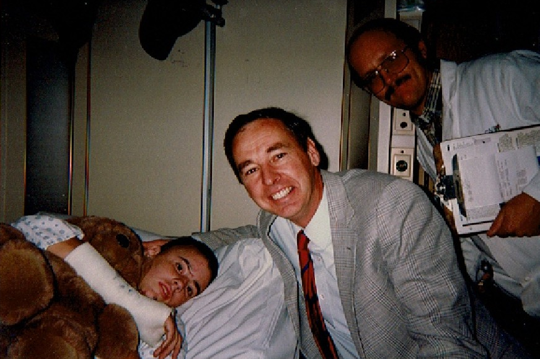
Kate’s recovery was long and difficult. She spent 10 days in the ICU, and stayed at St. Charles hospital for five weeks total. Afterwards, she was transferred to the Portland Emanuel Hospital for over a month. She was discharged in mid-December of the same year, having been hospitalized for around three months.
With retrograde amnesia, Kate had to relearn everything—how to walk, talk and write, the names of friends and family. She remembers being tired from the hard work it took to recover her skills. “I would wake up and they would wheel me downstairs for PT and then they’d wheel me upstairs for speech,” she recalls. “My recovery was just gaining basic skills.”
Recovery continued even after Kate left the hospital. She attended outpatient therapy several times a week and missed nearly a year of high school. What stands out most to her about that time was how hard it was to transition from the hospital to her home. “The hospital had become my home,” she says. “And after brain injury, there’s never really a point where someone can say, ‘I’m all better.’ There’s a lot of skills I never regained. There’s some things I still can’t do because of my injuries.”
After Kate recovered enough to return to everyday life, she volunteered at Emanuel Hospital, the same hospital where she had received treatment. She helped care for patients and spent time observing the care being given to others. “I just have so much respect for nurses and doctors and the whole health care system,” she says.
Today, Kate is a licensed professional counselor in private practice. She specializes in working with people who have acquired brain injuries. Her recovery showed her how difficult brain injuries can be to understand, even for professionals. Because she knows what it is like to face a long, difficult recovery, she has learned to be patient with herself and can empathize with people experiencing brain injuries, loss, depression or anxiety. “I can really identify with clients who are struggling in different ways,” she says. “It’s not just stuff that I learned from textbooks or in graduate school. It’s stuff I’ve experienced.”
Kate emphasizes that the blood she received after the crash was an important part of her treatment. “I wouldn’t be a mental health practitioner doing psychotherapy if it wasn’t for every person that was involved in saving my life, including the people who gave me blood.”
If she could speak directly to the people whose blood helped her survive at 16, she would want them to know that their decision mattered. “[Their] blood played a big part in my survival,” she says, “And I don’t know what would have happened if the blood wasn’t available.”
Kate eventually began donating blood herself, and her reason for donating is simple: she knows there is a need, and she has always wanted to help. “It’s just knowing that there’s a need out there and my desire to always help people in some way,” she says. Her message to someone unsure about donating is straightforward: one donation can become part of someone else’s chance to survive. “Your [blood donation] could very easily save someone’s life,” she says. “And there’s always a need. I can say it’s just if it’s very rewarding, and the environment where I donated blood at the Red Cross was very welcoming and comfortable.”
When Kate donates blood now, she is participating in something she once depended on herself. She hasn’t specifically imagined her blood going to someone in a situation identical to hers, but she hopes it can help someone facing a serious accident. “I just hope that my blood can help someone,” she says.