50 Years of Service: One Nurse’s Journey Through the Evolution of Blood Medicine
Written by Allison Skoglind, Red Cross Volunteer
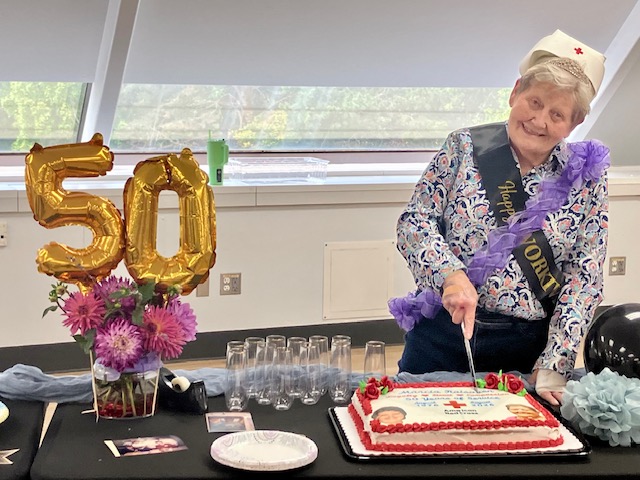
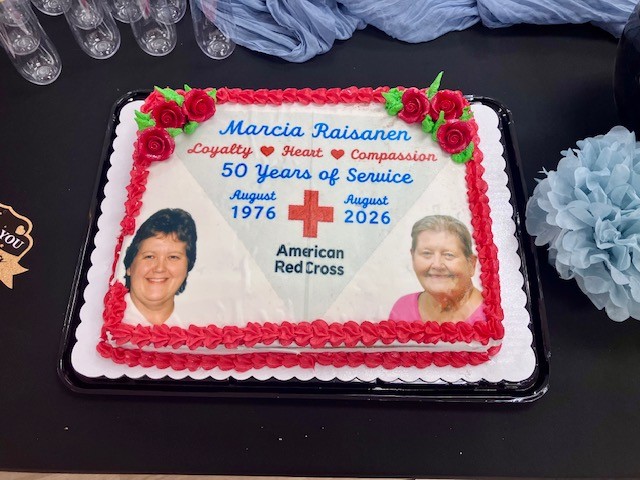
The American Red Cross recently hosted a celebration honoring Marcia Raisanen’s remarkable 50 years of service. What was scheduled to be a two-hour event extended well beyond its allotted time as a steady stream of current and former colleagues stopped by to reconnect, share memories and congratulate Marcia on this extraordinary milestone. The gathering was a testament to the lasting impact she has made on the organization and the many people whose lives she has touched throughout her career.
When Marcia first walked through the doors of the American Red Cross 50 years ago, donor information was recorded on paper cards, and senior nurses still remembered storing blood donations in glass bottles. Marcia arrived at the Red Cross after a friend casually suggested she apply during a night out.
That chance suggestion became the beginning of a five-decade career dedicated to patients, donors and the people around her.
Today, Marcia works part time as a clinical specialist and trainer, caring for hospital patients at their bedside or in outpatient clinics in Portland, Oregon. She also shares the expertise she has gained over half a century with the next generation of health care professionals.
Her journey offers a unique look at how far blood medicine has come, while showing how much one nurse can contribute to the people and communities she serves.
Discovering a Calling Across Oregon
Marcia began her Red Cross journey working on blood drives throughout Oregon. Each week, her team traveled to communities across the state, conducting blood drives and connecting with local donors.
For a young nurse who had grown up in Astoria and rarely ventured beyond her hometown, the work was transformative.
“I had never really gotten very far away from my hometown,” Marcia recalls. “That gave me the opportunity to see the rest of the state and meet a lot of nice people.”
Those early trips introduced her to diverse communities and to a medical field on the brink of significant change. Healthcare providers were beginning to move away from standard whole-blood transfusions, learning instead to separate blood into specific components, such as platelets and plasma, so patients could receive what they specifically needed.
Growing Alongside a Rapidly Changing Field
As the science advanced, so did Marcia’s leadership. After serving as a staff nurse and then head nurse, she trained in apheresis, a specialized process that uses automated technology to separate and collect targeted blood components during donation.
As demand for platelets grew, Marcia stepped up to manage an expanding apheresis program that grew from five to 22 donor beds. Her technical skill and organizational leadership later brought her to Tucson, Arizona, where she was asked to evaluate and build out an apheresis facility.
Her leadership had made such an impression in Portland that several Red Cross colleagues followed her to Tucson, eager to continue working alongside her.
What was intended to be a short assignment turned into a vibrant 28-year chapter.
As Director of Apheresis in Tucson, Marcia managed collection services while overseeing therapeutic treatments for hospitalized patients. She also helped establish apheresis programs across Richland, Kennewick and Pasco, Washington.
“It was a great challenge,” she says. “And it was a lot of fun.”
A Front-Row Seat to Five Decades of Progress
Over five decades, Marcia has watched advances in blood medicine transform both the way donations are collected and the way patients are treated. Early in her career, she saw firsthand how limited cancer treatment could be.
“When I was first working here, my 8-year-old cousin got leukemia, and there was nothing they could do for him. Basically.”
Decades later, seeing how treatment options and outcomes for children with cancer have changed remains one of the most meaningful examples of medical progress Marcia has witnessed.
Donor safety tools evolved just as dramatically. Marcia recalls when donor hemoglobin eligibility was tested using a basic copper sulfate solution. A single drop of blood was placed into a glass vial, and whether it sank or floated determined if a donor had sufficient red blood cells to give.
Today, more precise hemoglobin testing helps assess donor eligibility and safety before every procedure.
“It’s so much safer for the donors the way we do it now,” Marcia says.
Embracing the Future: Cellular Therapies
Even after half a century, Marcia remains energized by what lies ahead. She is particularly passionate about the rise of cellular therapies, such as CAR T-cell therapy, an innovative process in which a patient’s own immune cells are re-engineered to target cancer.
She has watched the Red Cross expand beyond traditional blood drives and become increasingly involved in emerging cellular technologies.
“It may look like we’re just doing the blood drives of old,” she says. “But we’ve evolved into a blood business…blood technology. It’s exciting to be on the cutting edge of things right now.”
For Marcia, that evolution is one of the most exciting parts of the field. She encourages nurses and other health care professionals to keep learning, explore emerging treatments and take advantage of opportunities to deepen their expertise.
A Legacy Built on Service
While tools and techniques have changed dramatically, Marcia’s primary motivation has remained the same.
“Being of service to the patients,” she says. “Whether it was on the donor side or the patient side. It was just about making their life better.”
Looking back on the mark she leaves behind, Marcia points not to equipment or administrative milestones, but to mentorship and education. She believes that helping colleagues discover their strengths and build confidence is one of the most enduring contributions a nurse can make.
“I would hope that people would say, she wanted to teach us something,” she says.
That commitment to teaching may be one of the clearest measures of Marcia’s legacy. Her colleagues followed her from Portland to Tucson, and today she continues to share what she has learned with the next generation of health care professionals.
Fifty years after taking a chance on a friend’s career tip, Marcia continues to teach, guide and inspire. Her story is a reminder that while technology and medicine continue to evolve, the heart of health care remains human connection and a commitment to service.
How You Can Help
Marcia’s story is a reminder that the Red Cross mission depends on people who show up to help others. Nurses, biomedical professionals, volunteers and donors all play an important role in ensuring the Red Cross can continue its lifesaving work.
There are many ways to be part of that mission:
Donate Blood: Schedule your next blood or platelet donation appointment.
Explore Careers: Discover clinical and nursing opportunities with the American Red Cross.
Volunteer: Join a regional team to support local blood drives and disaster relief efforts.
For more information on how you can help make a difference, visit the RedCross.Org today.